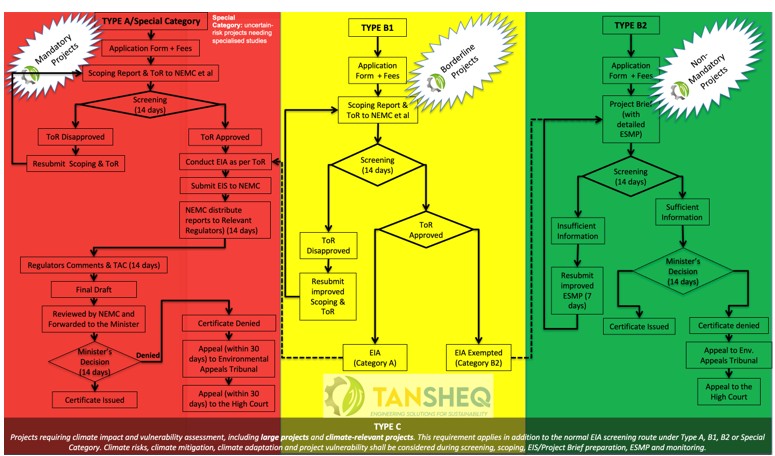
The flowchart above summarises how projects are registered, screened and approved under Tanzania’s Environmental Impact Assessment system. The process is anchored in the Environmental Management Act, Cap. 191 and the Environmental Impact Assessment and Audit Regulations, 2005, as amended in 2018 and 2024. The Regulations prohibit implementation of projects requiring EIA unless the EIA has been concluded and approved, and they require licensing authorities to ask for an EIA Certificate where EIA is required.
Under the 2018 Amendment Regulations, projects are classified as Type A, Type B1, Type B2 and Special Category, depending on the magnitude of their likely environmental impacts. In the flowchart, Type A and Special Category are shown in the red zone, Type B1 is shown in the yellow zone, and Type B2 is shown in the green zone.
For Type A projects, the red zone in the flowchart, a full EIA is mandatory. The proponent submits an application, fees, Scoping Report and Terms of Reference to NEMC. Once the Terms of Reference are approved, the full EIA study is conducted, an Environmental Impact Statement is submitted, and the report is reviewed by NEMC, relevant regulators and, where necessary, the Technical Advisory Committee before being forwarded to the Minister for decision.
For Special Category projects, also shown in the red zone in the flowchart, the likely environmental risks are uncertain and specialised studies may be required. These projects are treated as mandatory EIA projects and follow the Type A process.
For Type B1 projects, the yellow zone in the flowchart, the project is treated as borderline. NEMC screens the Scoping Report and Terms of Reference to determine whether a full EIA is required. If significant impacts are likely, the project moves to the Type A route. If impacts are manageable and mitigation measures are adequate, the project may be recommended for approval without a full EIA.
For Type B2 projects, the green zone in the flowchart, the project is considered lower risk or non-mandatory for full EIA. However, it is still submitted to NEMC through a Project Brief prepared by a registered environmental expert, including a detailed ESMP and Monitoring Plan. NEMC examines the Project Brief within 14 days and, where mitigation measures are insufficient, may require resubmission within 7 days. If satisfied, NEMC recommends approval to the Minister, who may approve or disapprove the project within 14 days.
The 2024 Amendment Regulations added Type C, shown as the bottom band in the flowchart. Type C refers to projects requiring climate impact and vulnerability assessment, including large projects and climate-relevant projects related to energy, transport, water, agriculture, forestry, land-use planning and land-use management. Type C does not replace the red, yellow or green routes; it is an additional climate requirement applied alongside the relevant Type A, B1, B2 or Special Category process.
A public hearing may be required where NEMC considers it necessary for a fair decision or environmental protection. Where required, the public hearing process can extend the approval timeline because the hearing must be advertised, conducted, documented and considered before the final decision is made.
Indicative EIA Certificate Timelines
|
Project type in the flowchart |
Main approval route |
Practical estimated duration |
|
Type B2 — green zone |
Project Brief + detailed ESMP + Monitoring Plan |
4–6 weeks |
|
Type B1 — yellow zone, approved without full EIA |
Scoping Report + ToR + screening |
6–8 weeks |
|
Type B1 — yellow zone, upgraded to Type A |
B1 screening followed by full EIA |
3–5 months |
|
Type A — red zone |
Full EIA / ESIA |
3–6 months |
|
Special Category — red zone |
Specialised study + Type A route |
4–6 months, depending on complexity |
|
Type C — bottom band |
Climate impact and vulnerability assessment added to the applicable route |
Follows the underlying Type A, B1, B2 or Special Category timeline; may add 1–3 weeks for simple projects |
|
Where public hearing is required |
Public notice, hearing, report and response to issues raised |
Add at least 3–4 weeks; practically 1–2 months for sensitive projects |
In practice, the actual approval time depends on the completeness of project information, proof of land ownership and location, quality of the ESMP, site sensitivity, stakeholder concerns, regulator comments, public hearing requirements and whether NEMC requests additional studies or revisions.

Published by TANSHEQ Limited.